

For years, we’ve measured crypto success by asking one question: Who owns the most crypto? But what if we’ve been asking the wrong question? A new Crypto Livability Report published by Genghis Pro flips the script – and the results are surprising.
Switzerland tops the rankings as the best country to actually live a crypto-powered life, Singapore and El Salvador round out the podium, while the United States languishes in 11th place despite being one of the world’s largest crypto markets.
At the bottom sits Sweden, proving that the most highly developed economies aren’t exactly crypto-friendly. The future of crypto isn’t just about adoption – it’s about usability.
This is precisely where the Crypto Livability Index introduces a fresh perspective. Rather than asking, “How many people use crypto?” it asks a much more practical question:
“Can someone realistically build a financial life around cryptocurrency in this country?”
That simple shift in perspective makes the index significantly more valuable for investors, entrepreneurs, digital nomads, and long-term crypto believers.
Why Adoption Alone Is No Longer Enough
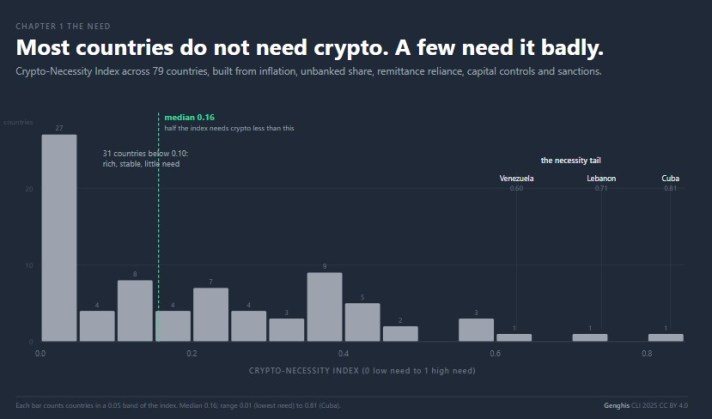
Crypto adoption has exploded over the past decade. Millions of people now own Bitcoin, Ethereum, stablecoins, or other digital assets. Institutional investors have entered the market, governments have begun regulating the industry, and blockchain technology has evolved far beyond speculative trading. For a long time, the crypto industry bragged about “adoption numbers”, like how many millions of people owned cryptocurrencies in the US or UK. But the Genghis report makes a brutal distinction: owning crypto as an investment is not the same as living on it.
This distinction is increasingly important as the industry matures.
To prove this, the report looks at “Raw Rails” (the technical infrastructure like exchanges and cards) versus “Need-Weighted Livability” (how much people actually rely on crypto to survive due to inflation or weak local banks). When you look at the top and bottom of the index, the difference between having the tech and actually needing it becomes crystal clear.
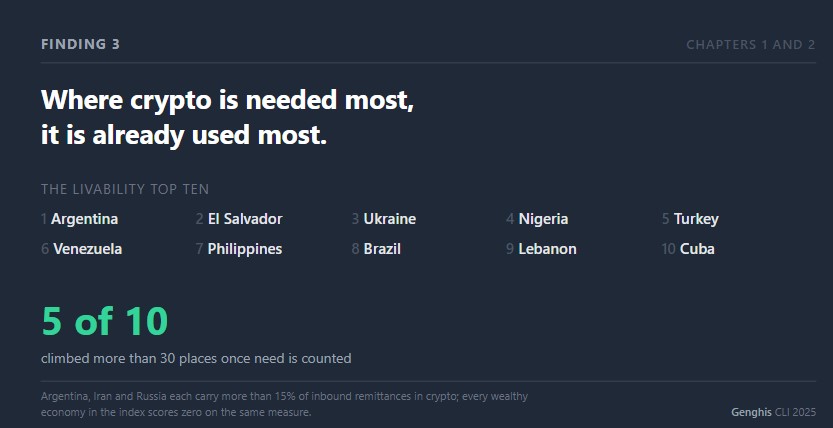
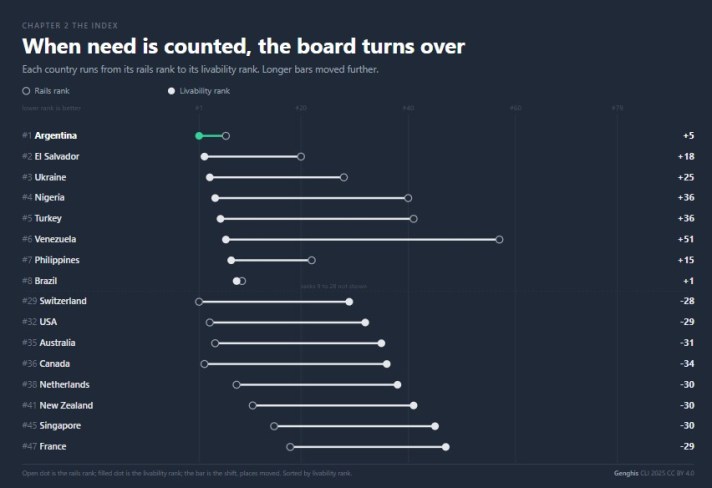
The Livability Leaders (High Need + Solid Rails): Argentina ranks #1 in the world for true crypto livability. Why? Because while its raw infrastructure sits at #6, its extreme economic necessity pushes it to the absolute top. El Salvador sits at #2 for livability, skyrocketing up 18 places from its raw technical rank due to massive local demand and legal adoption. Ukraine (#3) and Nigeria (#4) follow a similar pattern, where citizens use crypto as an essential everyday financial layer.
The Infrastructure Giants (High Tech + Zero Need): Look at Switzerland. It ranks #1 in the world for raw crypto capability—it has the best legal frameworks and tech rails on earth. But on the headline Livability Index? It plummets 28 spots to #29. The United States ranks #3 for raw tech infrastructure but drops 29 places to #32 for day-to-day livability. Canada ranks #2 for raw rails but experiences the index’s heaviest developed-world drop, crashing 34 places to #36. When your local fiat currency is stable and banks work perfectly, nobody is highly motivated to use crypto to buy their morning coffee.
The Bottom of the List (No Rails + No Access): At the absolute bottom of the 79-country index sit Nepal (#76), Ethiopia (#77), Iraq (#78), and Algeria (#79). These nations have virtually zero infrastructure, and heavy legal restrictions make living on crypto a near-impossibility.
What Exactly Is Crypto Livability?
Crypto livability measures how practical it is for individuals to use cryptocurrency as part of their daily financial lives.
Instead of focusing exclusively on ownership statistics or trading activity, it evaluates the broader environment that supports digital asset participation.
Several real-world factors contribute to this assessment: accessibility of exchanges; banking integration; Internet infrastructure; regulatory clarity; tax treatment; employment opportunities; merchant acceptance; stablecoin usage; cultural acceptance; and availability of blockchain businesses.
Together, these variables paint a much more realistic picture of what life is actually like for crypto users.
The Three Core Pillars
One of the strongest aspects of the methodology is that it simplifies a complex ecosystem into three intuitive pillars.
1. Usability
Usability measures how easy it is to access and use cryptocurrency.
Questions include: Can residents easily buy crypto? | Are reputable exchanges available? | Is internet infrastructure reliable? | Are payment services widely supported? | Can users move between crypto and fiat without friction?
High usability means crypto is accessible rather than complicated.
2. Livability
Livability evaluates whether crypto can realistically support someone’s financial life.
This extends beyond investing. It considers: Legal certainty | Regulatory transparency | Tax environment | Employment opportunities | Remote work | Freelancing | Staking income | Crypto salaries
This pillar is especially important for digital entrepreneurs and remote workers. A country with strong livability makes it easier to earn, spend, save, and invest using digital assets.
3. Adoption
Adoption focuses on the social and cultural side of cryptocurrency. Rather than measuring only wallet addresses or transaction counts, it looks at how embedded crypto has become within society. Indicators include: | Public awareness | Business acceptance | Media coverage | Blockchain events | Startup ecosystems | NFT communities | Web3 innovation
Adoption reflects whether crypto has become part of mainstream economic life rather than remaining a niche investment.
Why This Matters for Investors
Professional investors increasingly recognize that regulation and infrastructure often matter more than short-term market sentiment. Countries with supportive environments tend to attract blockchain startups, venture capital, institutional investment, developers and this drives fintech innovation.
These ecosystems create long-term value that extends beyond speculative price movements. As history has repeatedly shown, innovation tends to flourish where regulation is predictable rather than hostile.
Digital Nomads, Pay Attention!
Crypto has fundamentally changed the way many professionals earn income. Freelancers, consultants, software developers, content creators, traders, and entrepreneurs now receive payments from clients across multiple continents. For these individuals, crypto-friendly jurisdictions provide tangible advantages: faster payments, lower transfer costs, easier banking, greater financial flexibility, and simplified cross-border transactions. In this context, livability becomes just as important as internet speed or cost of living.
If you want a balance of high-end infrastructure and high day-to-day crypto usability, look at countries like the Philippines (#7) and Brazil (#8). The Philippines ranks #22 for raw rails but jumps 15 spots on the livability index because its local digital payment ecosystems are highly integrated with crypto.
Brazil ranks #9 for raw capability and holds strong at #8 for livability, making it incredibly friendly for remote workers wanting to spend crypto locally.
Many nomads flock to places like the United Arab Emirates (UAE) or Singapore because of their crypto-friendly reputations. But the report offers a major reality check. The UAE ranks #10 for raw capability but drops 17 spots to #27 for actual day-to-day livability. Singapore ranks #15 for rails but crashes 30 spots to #45 for livability.
Why? Because these sophisticated financial hubs have built incredible systems for institutional crypto businesses, but their day-to-day retail environments are heavily regulated, and the anonymous on-ramp is completely extinct.
The Bill Wall Warning: No matter where you travel, even in top-tier nomad destinations like Portugal (#39) or Thailand (#24), the report warns that you will eventually hit the “bill wall.” While you can easily use crypto to buy flights, book hotels, or purchase gift cards for daily retail spending, paying local utility bills or official apartment rent directly from a self-custody wallet remains a massive hurdle.
The Rise of Stablecoin Economies
One emerging trend reflected in modern crypto ecosystems is the growing importance of stablecoins and this report gives us an updated overview on the use cases and popularity of these.
While Bitcoin remains the flagship digital asset, stablecoins increasingly power real-world commerce. Businesses use them for payrolls, international settlements, remittances, supplier payments and treasury management.
Consumers benefit from reduced volatility (usually microscopic, thus making them ideal for transacting); lower transaction fees, faster settlement, and easier (cheaper and faster) international transfers.
Countries embracing stablecoin infrastructure often score well because they demonstrate practical crypto utility rather than speculative enthusiasm.
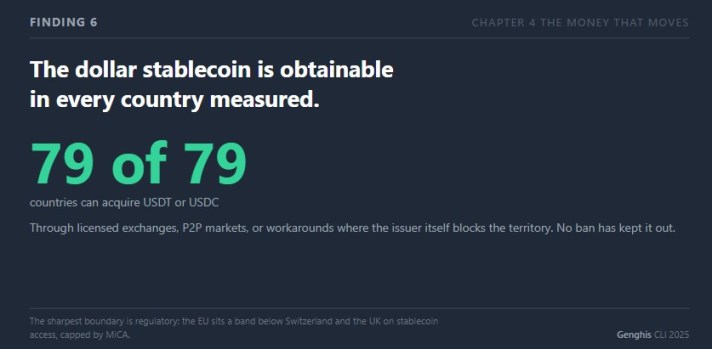
The report reveals an astonishing stat: the dollar stablecoin is accessible and actively used in all 79 countries surveyed. Absolutely no legal ban or government restriction managed to keep it out.
The countries leading the charge in stablecoin usage aren’t tech hubs; they are necessity-driven markets facing harsh economic realities:
In countries like Venezuela (#6), Lebanon (#9), Cuba (#10), and Russia (#11), stablecoins have become an alternate, parallel currency. When a country faces hyperinflation, local banking collapses, or international sanctions, peer-to-peer stablecoin networks become the primary way citizens hold onto their wealth and transact.
In nations like Turkey (#5), Pakistan (#18), and Iran (#23), strict capital controls limit how much foreign currency citizens can legally buy. The report highlights that capital controls are completely losing to a “detection problem” – people are using stablecoins to quietly move their money out of weak local currencies, and governments simply don’t have the tools to track and stop it.
Regulation Is Becoming a Competitive Advantage
For years, many believed regulation would slow innovation. The opposite increasingly appears true. Clear regulations reduce uncertainty. Businesses know how to operate, banks know how to provide services, investors understand the rules. Developers can build products without fearing sudden policy changes. Jurisdictions that establish balanced regulatory frameworks often attract higher-quality blockchain companies and institutional capital.
In today’s market, regulatory clarity has become one of crypto’s strongest competitive advantages. Countries that see the biggest crypto adoption are often those with the most clear regulatory frameworks.
One of the most fascinating statistics in the report highlights a major warning for users chasing total tax exemptions: every tax zero in the index is a ban. The data shows that when a country registers a “zero” for crypto tax infrastructure, it isn’t because they are a libertarian paradise; it’s because the government has banned crypto entirely, meaning there is no legal framework to tax it in the first place. You see this clearly at the bottom of the index in nations like China (#75), Nepal (#76), and Algeria (#79), where total bans have crushed local development and driven the entire ecosystem underground.
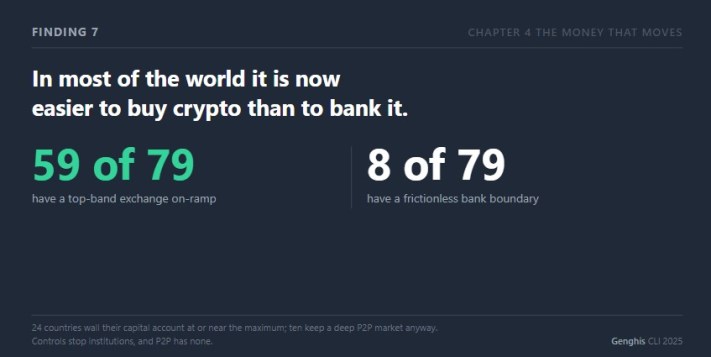
There is, however, a clear tradeoff to this regulatory safety. The report notes that the anonymous fiat-to-crypto on-ramp is officially extinct, and this reality is heaviest in the most sophisticated, highly regulated markets like Switzerland (#29), the United States (#32), and Germany (#33). In these nations, strict regulatory enforcement has successfully locked down compliance. If you want to move traditional cash into the crypto ecosystem in these high-ranking capability hubs, you have no choice but to go through rigorous identity verification (KYC). Regulation provides the rails, but it completely strips away anonymity.
The Countries Setting the Standard
Several jurisdictions consistently appear among the world’s most crypto-friendly environments because they combine strong infrastructure, progressive regulation, and growing adoption.
These include financial hubs that have successfully integrated digital assets into broader economic strategies rather than treating cryptocurrency as a fringe technology.
What separates these leaders is not simply higher ownership rates. Instead, they provide environments where individuals can confidently: earn crypto, spend crypto, save in crypto, build blockchain businesses, access financial services, participate in Web3 innovation. This holistic approach is what distinguishes mature crypto ecosystems from emerging ones.
The Global Standard for Infrastructure:
Switzerland (#1 Raw Rails) If you want to look at the absolute gold standard for technical, legal, and operational infrastructure, Switzerland takes the crown. It scores a massive 75 out of 84 on the report’s raw capability scoreboard. Thanks to its progressive legal framework (pioneered in hubs like the “Crypto Valley” in Zug), Switzerland has built an environment where crypto businesses, regulated exchanges, and institutional banking integrations exist in perfect harmony. However, because its citizens enjoy one of the most stable fiat currencies and traditional banking systems on Earth, it experiences a massive -28 place “Need Shift,” dropping it to #29 for daily livability. It is the ultimate proof that world-class tech rails mean very little if the population has no pressing everyday reason to use them.
The Global Standard for Daily Survival
Argentina (#1 Headline Livability) At the absolute top of the headline index sits Argentina, scoring 0.910 out of 1.000 for true crypto livability. While its raw technical infrastructure is already highly respectable at #6, its severe economic reality, driven by hyperinflation and rigid government limits on purchasing foreign fiat currency, pushes it up 5 places to the number one spot globally. In Argentina, the population has taken crypto out of the speculative realm and transformed it into a primary checking account. From paying for groceries via peer-to-peer stablecoin networks to hedging against the local currency’s daily devaluation, Argentina sets the global standard for crypto acting as a functional, necessary utility.
The Legal Pioneer
El Salvador (#2 Headline Livability) El Salvador holds a unique position as the world’s first nation to make Bitcoin legal tender, and the data reflects that bold political experiment. The country sits at #20 for raw rails, but experiences a massive +18 place upward shift to land at #2 overall for headline livability. By forcing the integration of digital asset infrastructure from the government level down to local merchant terminals, El Salvador has bridged the gap between raw capability and daily usage better than almost any other emerging market.
The Mass-Market Powerhouses
Ukraine (#3) and Nigeria (#4) Ukraine and Nigeria round out the absolute top tier of global standards, driven by explosive, necessity-fueled retail adoption. Ukraine climbs 25 places from its infrastructure rank to hit #3 for livability, largely due to crypto serving as a vital financial lifeline during ongoing geopolitical conflict. Meanwhile, Nigeria features one of the most dramatic leaps in the entire report: it ranks #40 for raw rails but rockets up an astonishing 36 places to rank #4 globally for true livability. Facing sharp local currency devaluation and a massive unbanked population, Nigeria’s retail market has bypassed traditional banking altogether, setting a massive standard for mobile-first, peer-to-peer crypto transactions.
In Conclusion
The cryptocurrency industry has reached a point where simple adoption statistics are no longer sufficient. The next phase of digital asset growth will be driven by infrastructure, regulation, financial accessibility, and real-world usability.
Crypto is evolving from a speculative investment into a functional financial ecosystem. As this transition continues, measuring how people actually live with cryptocurrency becomes far more meaningful than simply measuring how many people own it.
The Crypto Livability Index reflects this evolution by emphasizing practical utility over popularity. For investors, entrepreneurs, remote workers, policymakers, and anyone planning their long-term crypto strategy, understanding where digital assets can truly thrive may become one of the most valuable insights available. In the coming years, the countries that succeed will not necessarily be those with the most crypto holders—but those that make crypto genuinely livable.
When you look across all 79 countries in the index, the data paints an unmistakable picture of how digital assets actually move through the global economy. The numbers reveal that the global financial map is completely splitting based on practical utility rather than technical wealth.
The metrics confirm that high-end technical infrastructure does not translate into a crypto-first lifestyle. Instead, macroeconomic pressures, like inflation, strict capital controls, and high unbanked rates are the metric-driven forces pushing crypto into the status of a primary checking account.
Access the full Crypto Livability Index Report
Disclaimer: This article is for informational purposes only and does not constitute financial advice. Always conduct your own research and consult with a qualified financial advisor before making investment decisions.
Stay informed and level up your crypto strategy
 Sign Up for the Crypto Corner Newsletter and join 10,000+ users to receive my monthly updates and market analysis and keep up to date with the latest releases and developments in the crypto arena.
👉Go to LearnCryptoNow.com for free guides, tutorials and all things crypto

Billion-dollar Crypto Scams and How to Avoid Them
The crypto landscape is rife with scams, including Ponzi schemes and fraudulent exchanges that have led to immense financial losses. The article details all…

Why I stopped using Coinbase
CRYPTO CORNER VIDEO PODCAST #765 Coinbase is caught in a massive public showdown over allegations of covering up hacks. It started when a trader…
Daily Wisdom
“Don’t be afraid to give up the good to go for the great.” – John D. Rockefeller Sometimes we need to take bold steps…


