
Blockchains are isolated environments that require oracles to access external real-world data.
Decentralised oracles like Chainlink reduce manipulation risk and are essential for DeFi and prediction markets.
The security of smart contracts heavily depends on the trustworthiness and decentralisation of their oracle data sources.
Many crypto investors believe that blockchains are self-sufficient systems with access to all global data. However, this is not the case. By their very nature, blockchains are isolated environments that cannot extend beyond their own network to retrieve prices, confirm events, or check other external data. This limitation poses a significant challenge for any application that requires real-world data, which is precisely the issue that oracles solve. In this article I’ll explain what oracles are, how they function, the security challenges they present, and why they are essential to decentralised finance (DeFi), gaming, insurance, and cross-chain interoperability.
In summary:
- Oracles connect blockchains
- Oracles bring real-world data on-chain, powering smart contracts beyond isolated environments.
- They enable key DeFi use cases. Price feeds, insurance, and prediction markets depend on oracles for reliable off-chain data.
- Decentralization increases trust. Using multiple independent nodes helps ensure data is accurate and tamper-resistant.
- Oracle choice impacts security. Selecting secure, well-designed oracles is critical for safe DeFi and crypto applications.
What are oracles in crypto?
In blockchain tech, an oracle is a system that connects a blockchain to data sources outside of it. Think of it as the smart contract’s sensory layer. Without it, the contract can’t see anything happening outside of the chain. Oracles get information from external sources and send it to the blockchain so that smart contracts can work based on what is happening in the real world.
The main problem here is called the oracle problem. Blockchains don’t need trust, and they are deterministic, which means that every node must agree on the same result. But external data sources are not either of those things. A single, centralised data feed creates a point of failure and a trust assumption that goes against the whole idea behind decentralised systems. If that feed is changed or goes down, all protocols that depend on it are open.
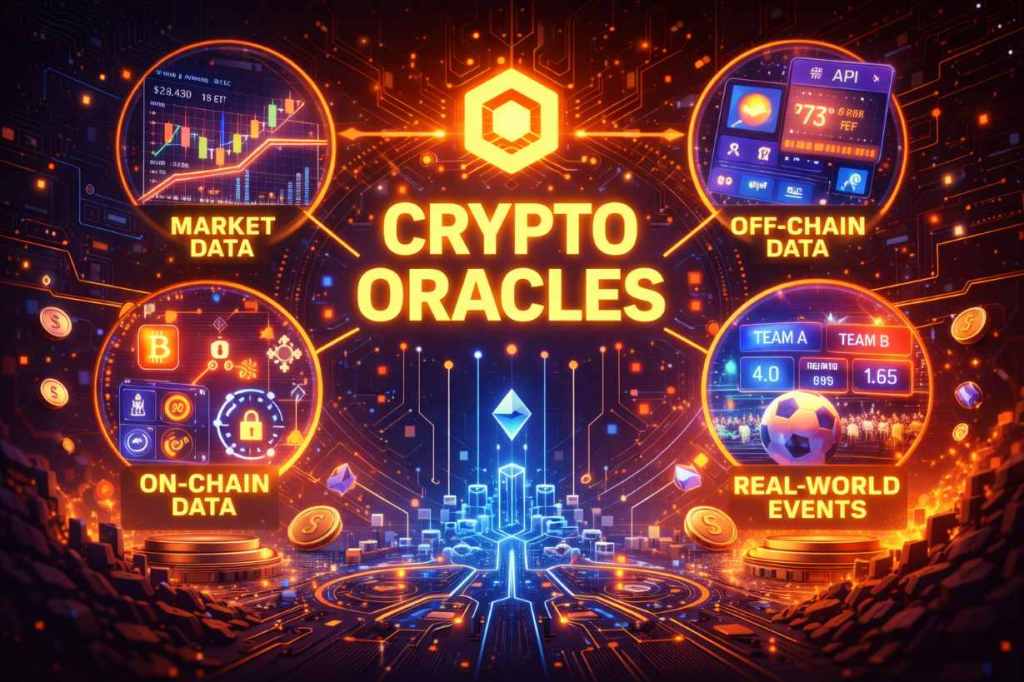
Oracles deliver a wide variety of data types, including:
- Price feeds: Asset prices for lending, borrowing, and liquidations
- Weather and environmental data: Used in parametric insurance contracts
- Sports and event outcomes: Powering prediction markets
- Randomness: Verifiable random functions (VRF) for gaming and NFTs
- Cross-chain messages: Enabling asset transfers between blockchains
On the technical side, oracles are divided into groups based on direction and method. External data is pushed onto the blockchain by inbound oracles. Smart contracts can send data or instructions to other systems through outbound oracles. Software oracles get their information from APIs and the web, while hardware oracles connect to real sensors or devices.
Understanding blockchain transparency mechanisms helps clarify why oracles are such a critical addition. The chain itself is transparent and verifiable, but it has no native ability to verify what’s happening outside its own ledger. Oracles bridge that gap, and as the Ethereum documentation confirms, they enable key DeFi applications including price feeds for lending and liquidations on platforms like Aave and Compound, parametric insurance, prediction markets, NFT gaming through VRF, and cross-chain interoperability.
Pro Tip: Before committing capital to any DeFi protocol, research which oracle solution it uses. A protocol is only as reliable as the data feeding it.
Why oracles are essential for DeFi and beyond
Now that we have a good definition, let’s look at why oracles are so important. There are no employees or managers in DeFi protocols who make decisions. They run on code, and that code needs data that is accurate and up to date all the time to work right. Automated lending platforms like Aave and Compound couldn’t work without oracles.
DeFi operations that oracles make possible across multiple sectors:
- Lending and liquidations: Price feeds determine when a borrower’s collateral falls below a safe threshold, triggering automatic liquidations to protect lenders
- Prediction markets: Platforms need verified event outcomes, whether an election result or a sports score, to settle bets correctly
- Parametric insurance: Contracts pay out automatically when oracle-verified conditions are met, such as rainfall dropping below a set level
- NFT gaming: Verifiable randomness ensures fair outcomes in loot drops, character stats, and in-game events
- Cross-chain interoperability: Oracles relay messages and asset data between separate blockchains, making multi-chain strategies viable
The stakes are high. A manipulated price feed can cause mass liquidations, which can take millions of dollars from a protocol in just a few minutes. That’s not a theoretical risk. Several major DeFi hacks have been linked to oracle manipulation, in which hackers used flash loans to change the prices of assets and steal a lot of money from decentralised protocols.
The growth of prediction markets has accelerated a lot, and as prediction market aggregation gets better, the need for reliable oracle infrastructure grows with it. The same is true for the adoption of crypto gaming, where verifiable randomness is not just a nice feature but also a must-have for players to trust.
The Ethereum oracle documentation confirms that oracles make all kinds of DeFi use cases possible, from lending and liquidations to insurance, interoperability, gaming, and more. Without them, blockchain applications would be limited to on-chain data only, which is a severe constraint on utility.
Pro Tip: Check the protocol documentation for which Oracle solution powers it. If that information isn’t publicly available, treat it as a red flag.
How decentralised oracles work: Security models and innovations
Now that we know what they do, let’s see how oracles really give us reliable data. The most important difference in oracle design is whether it is centralised or decentralised. A centralised oracle depends on one source or operator, which makes it vulnerable to failure. A decentralised oracle network (DON) collects data from many separate nodes, which makes it much harder and more expensive to change.
Chainlink is the most popular DON in this area. It uses a system called Offchain Reporting (OCR), where nodes get data on their own, agree on it off-chain, and then send a single report on-chain. This lowers the cost of gas fees while still providing strong security guarantees. Chainlink’s architecture also uses heartbeat updates and deviation thresholds. This means that data is pushed on-chain when it goes above a certain percentage or at regular time intervals, whichever comes first.
How Oracles deliver data:
Oracles serve as crucial intermediaries that deliver real-world data to smart contracts, enabling them to execute based on external information. Centralised oracles rely on a single source for data, which can lead to vulnerabilities, as the integrity of the data is dependent on that single point of failure. This makes them susceptible to manipulation or outages.
In contrast, decentralised oracles aggregate data from multiple independent sources, enhancing reliability and security. By distributing the data collection process across various nodes, decentralised oracles mitigate risks associated with data tampering and ensure a more robust and trustworthy data feed for smart contracts.
This fundamental difference highlights the importance of choosing the right type of oracle based on the specific needs and risk tolerance of the application.
For protocols handling next-generation privacy chains or sensitive financial data, the quality of the oracle layer is arguably more important than the smart contract code itself. A perfectly written contract is still vulnerable if the data feeding it is compromised.
If you’re tracking crypto prices across multiple platforms, you’re already consuming aggregated data similar to what DONs provide to smart contracts.
Pro Tip: Evaluate whether an oracle is truly decentralised before trusting critical dApps with significant capital. Look for the number of independent node operators, data sources, and any on-chain transparency reports.
Notable examples: Real-world use cases of oracles in crypto
Let’s reinforce the concepts with real-world examples and their outcomes. Oracles aren’t abstract infrastructure. They’re actively running in protocols you may already use.
Aave and Compound: Both platforms use Chainlink’s price feeds to determine collateral values and trigger liquidations. Without accurate, real-time pricing, the entire lending model breaks down.
Chainlink VRF: Verifiable Random Function provides cryptographically provable randomness for blockchain games and NFT projects. It ensures that no party, including the protocol itself, can predict or manipulate outcomes.
Parametric insurance: Platforms like Arbol use weather oracle data to automatically pay out crop insurance claims without requiring manual claim processing.
Cross-chain bridges: Oracle networks relay asset prices and state data between chains, enabling decentralised bridges to operate without centralised custodians.
| Protocol | Use case | Oracle provider |
| Aave | Lending and liquidations | Chainlink |
| Compound | Collateral pricing | Chainlink |
| Synthetix | Synthetic asset pricing | Chainlink |
| Polymarket | Event outcome verification | UMA / custom |
| Axie Infinity | In-game randomness | Chainlink VRF |
When you’re tracking crypto prices, it’s worth noting that the same aggregated data you see on price dashboards is what oracle networks deliver directly to smart contracts in real time. The difference is that smart contracts act on that data automatically, without human review.
The wide range of these uses shows that oracles are not just for a small group of people. They connect blockchain logic to the real world, and how reliable they are directly affects the safety of billions of dollars in locked assets.
Oracles, trust, and the future of decentralized data
So, in light of everything, here’s what we think most people miss about oracles. The crypto community puts a lot of effort into checking the code of smart contracts, and they are right to do so. But the oracle layer gets a lot less scrutiny, even though it’s just as important. In practice, the data that goes into many DeFi protocols is the weakest link, not the code of the contracts.
Most investors don’t realise that a protocol’s security model is only as strong as its oracle’s decentralisation. A well-audited contract can still be drained if its price feed is thin, easy to change, or only controlled by a small number of people.
Looking forward, the oracle space is evolving fast. We’re seeing early experiments with AI-influenced oracles that can process unstructured data, programmable privacy layers that protect sensitive inputs, and more transparent trust models that give communities direct oversight of data sources. These developments are worth watching closely.
Understanding trust in blockchain systems requires looking beyond the chain itself. Oracles are where that trust is either reinforced or broken.
Pro Tip: Monitor oracle upgrade proposals and governance discussions for protocols you’re invested in. Changes to the oracle layer can shift a protocol’s risk profile significantly.
Disclaimer: This article is for informational purposes only and does not constitute financial advice. Always conduct your own research and consult with a qualified financial advisor before making investment decisions.
Stay informed and level up your crypto strategy
 Sign Up for the Crypto Corner Newsletter and join 10,000+ users to receive my monthly updates and market analysis and keep up to date with the latest releases and developments in the crypto arena.
👉Go to LearnCryptoNow.com for free guides, tutorials and all things crypto

Quote Of The Day
“Don’t watch the clock; do what it does. Keep going.” – Sam Levenson Resilience and an unwavering spirit are the companions on the journey…

Billion-dollar Crypto Scams and How to Avoid Them
The crypto landscape is rife with scams, including Ponzi schemes and fraudulent exchanges that have led to immense financial losses. The article details all…
Why I stopped using Coinbase
CRYPTO CORNER VIDEO PODCAST #765 Coinbase is caught in a massive public showdown over allegations of covering up hacks. It started when a trader…


