The blockchain world is locked in a high-stakes race for scalability. Users demand speed and affordability, but popular networks often struggle with congestion and high fees. This struggle is vividly illustrated by the ongoing battle between the established giant, Ethereum, and fast-rising challengers like Solana.
While Ethereum remains a cornerstone of DeFi and NFTs, its Layer 1 (L1) network can feel sluggish and expensive during peak times, leading to user frustration. This cycle, we’ve seen Ethereum’s native token (ETH) underperform relative to competitors like Solana (SOL). Solana, boasting significantly higher transaction speeds and rock-bottom fees, has captured significant market share, developer interest, and user activity – particularly in areas like DEX trading and memecoins. Impressive metrics show Solana often surpassing Ethereum in daily transactions and even revenue generated in early 2025.
However, Solana’s rise hasn’t been without turbulence. Its history includes notable network outages (like the one in February 2024) and persistent questions around its relative centralization compared to Ethereum’s vast validator set.
Caught between maintaining its security/decentralization and needing to scale drastically, Ethereum’s answer lies heavily in Layer 2 (L2) solutions. These technologies are not just incremental improvements; they are fundamental to Ethereum’s strategy for survival and future dominance in the face of potent competition. But what exactly are L2s, and how do the main types – Rollups and Sidechains – differ?
The Need for Speed: Why Layer 1 Isn’t Enough
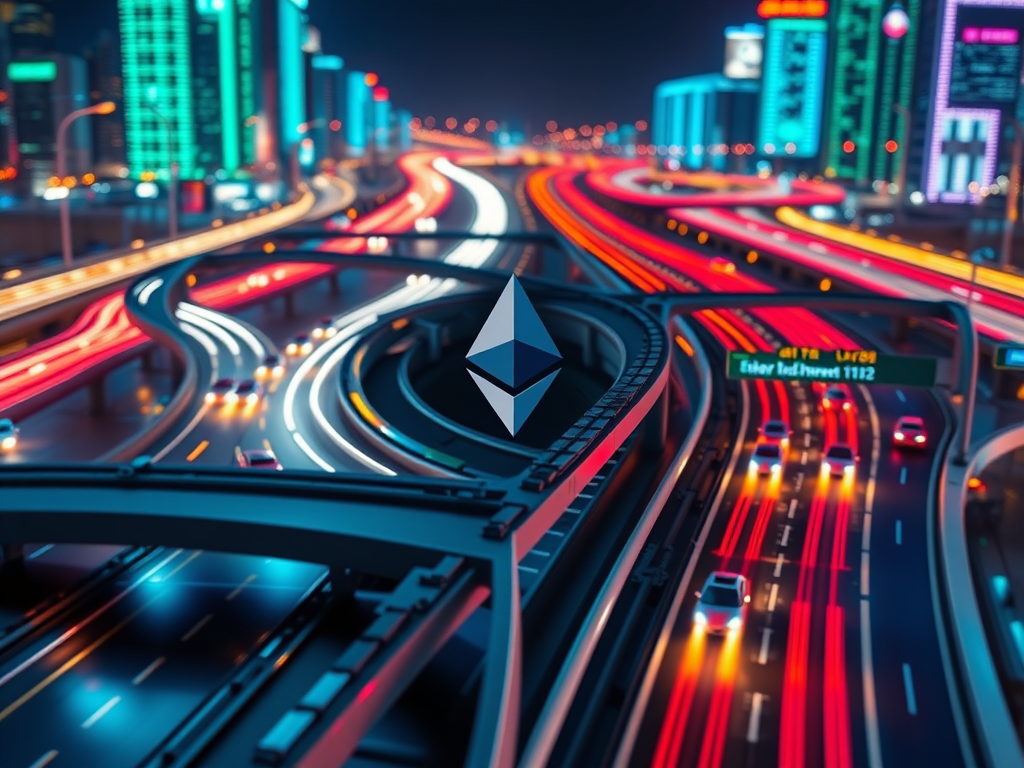
Imagine a single highway trying to handle rush hour traffic for an entire metropolis. That’s often the situation on Ethereum’s L1. When demand surges, the network clogs up, transaction confirmation times soar, and “gas fees” (the cost to transact) can become prohibitively expensive, sometimes exceeding the value of the transaction itself. This poor user experience pushes people towards faster, cheaper alternatives like Solana, which handles thousands of transactions per second (TPS) on its base layer for fractions of a cent.
Layer 2s: Building Express Lanes on Top
Instead of trying to perpetually widen the main highway (which is complex and slow), L2 solutions build express lanes on top of the existing L1 blockchain (like Ethereum). They process transactions off the main chain but typically anchor their security back to the L1. This allows them to offer significantly higher throughput and lower fees while inheriting the security guarantees of the underlying Layer 1.
Let’s explore the two dominant L2 approaches:
1. Rollups: Ethereum’s Preferred Scaling Path
Rollups are the centerpiece of Ethereum’s scaling strategy. They work by executing transactions off-chain, “rolling up” hundreds or thousands of them into a single batch, and then posting a compressed summary of that batch data back to the Ethereum L1. This dramatically reduces the load on the main chain while still leveraging its security. There are two main flavors:
- Optimistic Rollups:
- How they work: These L2s optimistically assume all transactions in a batch are valid by default. They post the data to L1 and allow a “challenge period” (often around 7 days) during which anyone can submit a “fraud proof” if they spot an invalid transaction. If challenged successfully, the incorrect transaction is reverted.
- Pros: Generally easier to achieve EVM (Ethereum Virtual Machine) compatibility, meaning existing Ethereum dApps can migrate relatively easily. Mature technology with significant adoption.
- Cons: Withdrawals back to Ethereum L1 are delayed by the challenge period.
- Examples: Arbitrum, Optimism, and Coinbase’s Base (which uses Optimism’s tech and has seen explosive growth in volume and Total Value Locked (TVL), recently surpassing $2.7 billion).
- Zero-Knowledge (ZK) Rollups:
- How they work: Instead of assuming validity, ZK-Rollups use advanced cryptography (like ZK-SNARKs or ZK-STARKs) to generate a validity proof for each batch of transactions. This proof mathematically guarantees the correctness of the transactions without revealing the underlying data. The proof is posted to L1.
- Pros: Faster finality for withdrawals (no long challenge period needed). Potentially offer better data compression and higher long-term scalability.
- Cons: Generating proofs is computationally intensive. Achieving full EVM compatibility (zkEVMs) is more complex and cutting-edge.
- Examples: zkSync, StarkNet, Polygon zkEVM, Scroll, Linea.
2. Sidechains: Parallel Universes
Sidechains operate differently from Rollups. They are independent blockchains that run parallel to a main chain like Ethereum, connected via a two-way bridge.
- How they work: Transactions are processed entirely on the sidechain, which has its own consensus mechanism and validators. Security is not directly inherited from the L1; it depends on the sidechain’s own design and validator set. The bridge facilitates asset transfers between the L1 and the sidechain.
- Pros: High flexibility and customizability. Can achieve very high throughput independently of the main chain.
- Cons: Users rely on the sidechain’s security model, which may be less robust than the L1’s. Bridge security itself is a critical point of potential failure.
- Examples: Polygon PoS (Proof of Stake) is a prominent example often categorized here, though its architecture is evolving. Gnosis Chain is another.
The Great Scaling Debate: Ethereum’s L2s vs. Solana’s L1
So, how do these L2s stack up against a monolithic, high-speed L1 like Solana?
- Solana’s Edge: Speed (thousands of TPS vs. Ethereum L1’s 15-30), incredibly low fees, and a simpler user experience (no bridging required for basic L1 activity) have driven its adoption, particularly for high-frequency activities. Its impressive performance metrics and market cap growth this cycle cannot be ignored.
- Ethereum’s L2 Counter: Rollups aim to bring Ethereum’s effective TPS into the thousands, drastically lowering fees while crucially retaining the security and decentralization of the main Ethereum network (with its ~1M+ validators vs. Solana’s ~2,000). The argument is that Ethereum’s modular approach (L1 for security + L2s for execution) offers a more robust and decentralized path to scaling long-term.
- The Trade-offs: Users choosing Solana accept its history of outages and lower decentralization for immediate speed and cost benefits. Users choosing Ethereum + L2s accept the added complexity of bridging and fragmented liquidity across different L2s for the perceived superior security and decentralization inherited from Ethereum L1.
The narrative that Ethereum is “fading” stems from its L1 limitations and the undeniable momentum Solana has built. However, Ethereum’s vast L2 ecosystem represents a powerful, albeit complex, strategy to address these very limitations. The success of platforms like Base and Arbitrum shows this strategy is gaining traction.
The Future is Layered (or is it?)
Layer 2 solutions, particularly Rollups for Ethereum, are no longer experimental concepts; they are essential infrastructure powering the next wave of blockchain adoption. They represent Ethereum’s best hope for scaling to meet user demand while preserving its core strengths.
The competition from fast, monolithic L1s like Solana is fierce and highlights the different philosophies towards achieving scale. Solana’s focus on optimizing the base layer offers compelling advantages in speed and cost, making it a formidable player despite its own challenges.
Ultimately, understanding the differences between Rollups and Sidechains, and their role in the broader Ethereum vs. Solana debate, is crucial for anyone navigating the crypto space in 2025. Whether Ethereum’s layered, modular future will prevail over Solana’s integrated, high-speed approach remains one of the most compelling questions in the industry today
Disclaimer: This article is for informational purposes only and does not constitute financial advice. Always conduct your own research and consult with a qualified financial advisor before making investment decisions.
Recommended:
 👉Sign Up for the Crypto Corner Newsletter and get more insight on the crypto markets, new releases and updates, plus my personal choice of coins to trade.
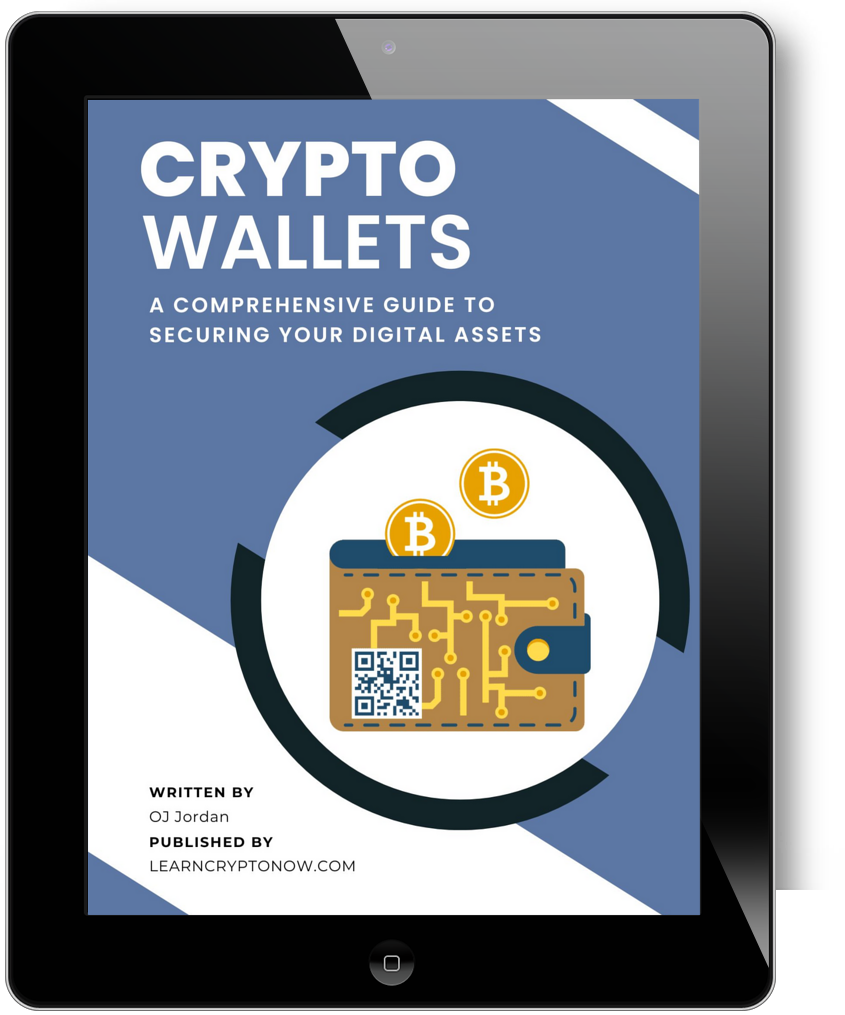 📖Free eBook “Best Crypto Wallets” is the best guide for all the top-performing crypto wallets. Both hot and cold wallets are reviewed by me and from personal experience.
 👉 LearnCryptoNow is the go-to place to get valuable resources and learn more about blockchain tech and all things crypto-related: https://www.learncryptonow.com/
 👉Brave Browser is my top choice for extra security while browsing online. It is privacy-oriented, web3-enabled and blocks unnecessary cookies and much more: https://brave.com/ojj095
 👉Token Metrics is the platform I use for uncovering unknown gems and to monitor my crypto watchlist. They have the most detailed statistics and analysis for all major cryptocurrencies and price predictions to help you find the right coins to trade and the right time to buy/sell – give it a try and get 10% discount: https://bit.ly/token_metrics

Want to know how to make money by investing in crypto?
Grab a copy of my best-selling eBook “Learn Crypto” to find out all about the cryptocurrency market, the different blockchains and the “Do”s and “Don’t”s of how to build a successful crypto portfolio. It’s now in its second edition.Find out more: LearnCryptoNow.com
“Crypto Wallets” is a Free eBook to guide you in choosing the right wallet for you. All the popular Hot and Cold Wallets are reviewed in this useful guide, most of which I personally use, or have used in the past. Self-custodial and custodial services too.
Find out more at: https://www.ojjordan.com/crypto
⚠️ DISCLAIMER ⚠️
The information contained in this video is for informational purposes only. Nothing herein shall be construed to be financial or legal advice. The content of this post reflects solely my own opinions. Purchasing cryptocurrencies poses considerable risk of losses.
How the ‘Clarity Act’ Will Affect Your Altcoin Bags
The Digital Asset Market Clarity Act (CLARITY ACT) is a landmark piece of U.S. legislation designed to replace “regulation by enforcement” with a formal…

All Major Crypto Hacks To Date (Updated List)
243 Entries to date. Last updated in Apr 2026. In this post, I collected data from various sources to compile a comprehensive list of…
Quote Of The Day
“Do not wait; the time will never be ‘just right.’ Start where you stand, and work with whatever tools you may have at your…

 Crypto-Corner