

CRYPTO CORNER VIDEO PODCAST #765
Coinbase is caught in a massive public showdown over allegations of covering up hacks. It started when a trader complained on X about losing $1.2M and getting banned after more than 30 ignored support tickets. This gained a ton of traction and it became an ongoing debate about the user experience at Coinbase – an exchange that once was the beacon of crypto, and my personal gate into the world of Bitcoin – I purchased my first Bitcoin there some 11 years ago but also, I stopped using their platform almost 8 years ago and here’s why.
For a long time people have complained about lack of customer service or poor customer experience with Coinbase and now we have a trader complaining on X about losing $1.2M and getting banned, only for Coinbase executive Cobie to dismiss it as a fake scam attempt. That immediately drew in BlockTower founder Ari Paul, who claimed Coinbase lost $25M of his firm’s funds years ago and kept it quiet, adding that he will publish a full dossier exposing repeated cover-ups if Coinbase agrees not to sue. I show you these tweets (posts) in the video episode of the podcast (above).
So, on one side, you have Coinbase: a publicly traded, multi-billion-dollar wall of compliance and regulatory posture, widely considered the safest gateway into crypto.
On the other side, you have retail traders, prominent venture capitalists, and the founder of a major institutional fund alleging a systemic, multi-year cover-up of breach losses.
We are talking about claims that start with a single lost wallet and escalate all the way to a staggering allegation: over one billion dollars in hidden hacks across the industry.
It all started with this tweet, on X: a post that originally looked like standard crypto customer support noise. A retail trader went public, claiming he had been drained of one point two million dollars.
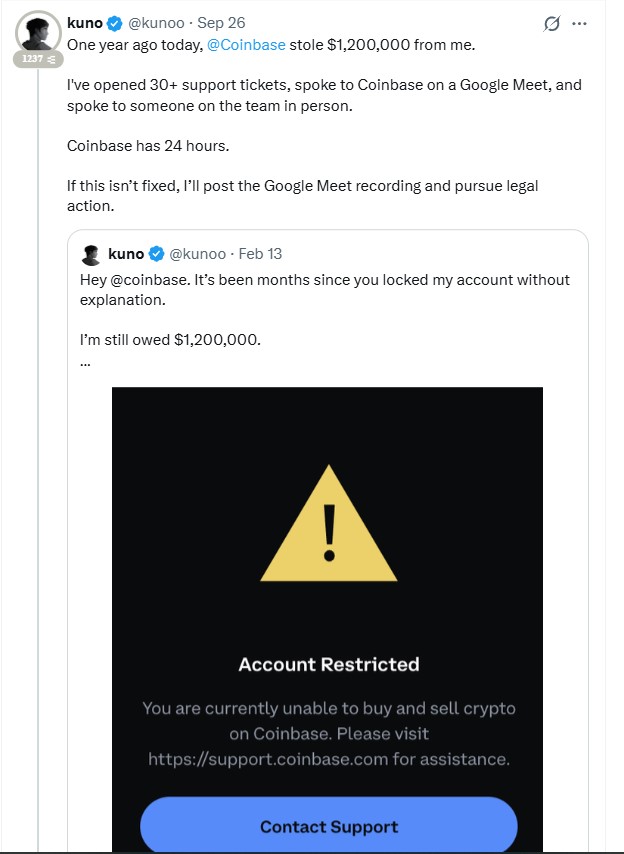
According to the trader, he submitted over thirty support tickets to Coinbase over a period of weeks, trying to figure out how his account was compromised and attempting to freeze his remaining assets.
Instead of getting resolution, he claimed Coinbase ignored the tickets and ultimately banned his account.
This is where the story took its first major turn. Jordan Fish, better known in the crypto community as Cobie, a prominent figure and advisor connected to Coinbase, publicly pushed back. He essentially brushed off the retail trader’s claims, implying the entire situation was a fake scam attempt or an attention grab designed to smear the exchange.
In normal circumstances, that might have been the end of it. A retail dispute gets lost in the noise, dismissed as user-side compromise or phishing.
Except this time, the dismissive reaction caught the eye of Ari Paul.
Ari Paul is not an anonymous account. He is the co-founder and Chief Investment Officer of BlockTower Capital, one of the most respected institutional investment firms in the digital asset space.
Seeing Cobie dismiss the retail trader triggered Ari Paul to jump directly into the thread with a bombshell statement of his own.
Paul publicly claimed that Coinbase had lost twenty-five million dollars of BlockTower’s own funds several years ago, and then quietly covered it up instead of transparently admitting to the breach and refunding the assets. You can read the tweet here, according to Paul, this was not an isolated user error. He alleges that his firm tracked at least twelve other institutional entities that suffered similar compromises under mysterious circumstances.
In total, Paul alleged that Coinbase has covered up more than one billion dollars in cumulative hacking losses across the industry over time.
Think about the scale of that claim. One billion dollars in undisclosed losses for a regulated, publicly traded company on NASDAQ.
The reaction on social media was explosive. Critics immediately demanded evidence, while legal observers pointed out the massive defamation risk if the allegations were false.
Ari Paul addressed this directly. He explained that ongoing legal proceedings and non-disclosure agreements prevent him from publishing the internal documents and communications unilaterally.
However, he issued a direct challenge to Coinbase’s legal team. He offered to release a full, comprehensive dossier exposing what he claims are repeated security cover-ups, on one single condition: Coinbase must sign a binding legal agreement promising not to sue him for defamation or breach of contract.
Essentially, Paul put the ball directly in Coinbase’s court: “If I am lying, sign the waiver, let me post the evidence, and let the public decide.”
So, how has Coinbase positioned itself through all of this?
Their public stance remains firm. The exchange maintains that its core cryptography, private keys, and cold storage architecture have never been breached.
They argue that when losses do occur, they are almost universally the result of sophisticated social engineering attacks targeting end-users, or localized breaches involving third-party support staff and overseas contractors—such as the customer service agent data leak incidents that targeted user metadata rather than central vault keys.
From Coinbase’s perspective, conflating third-party phishing or employee social engineering with a “systemic exchange hack” is factually incorrect and misleading.
Yet this dispute highlights a massive, growing rift in the cryptocurrency ecosystem.
For years, centralized exchanges have sold the public on a specific promise: “We are as safe as a traditional bank.” But in the traditional banking world, if an institution suffers a major operational breach, strict regulatory frameworks mandate public reporting, material loss disclosures, and mandatory insurance payouts.
When institutional giants like BlockTower Capital publicly claim that tens of millions of dollars can vanish into a cloud of non-disclosure agreements and silence, it undermines the fundamental premise of centralized custody.
It raises critical questions that every investor needs to ask:
First: Where is the line between a user-side phishing error and an exchange-side security failure?
Second: If institutional players are forced into years of private arbitration to resolve multi-million-dollar discrepancies, how can retail users ever expect fair treatment through a standard support ticket system?
And third: With regulatory scrutiny at an all-time high, can centralized exchanges continue to rely on NDAs to manage public relations around security incidents?
As of right now, the dossier remains unreleased, legal teams are active behind the scenes, and the public is left waiting to see if Coinbase will take up Ari Paul’s offer or let the dispute play out in private arbitration.
Whether these claims are eventually proven in court or dismissed as a misunderstanding of operational liability, one thing is clear: the era of keeping security disputes quietly contained behind customer support desks is officially over.
And Coinbase is now under fire as this incident triggered a lot of users who came forward and posted on X about accounts being frozen, so we know that this happens all the time at Coinbase. In the video above I show you some of these claims and there are a lot more.
So the bottom line is: this should raise a warning for anyone who’s keeping their coins on centralised platforms like Coinbase – simply don’t. At any point you can be the next one put in a situation where your funds are frozen, accounts locked, lack of customer support, and I personally know several people who had their Bitcoin frozen in Coinbase for “suspicious activity” – a very vague reasoning that doesn’t give any substance and you submit document after document to prove you’re not guilty, only to have no answer on the other side. Happened to many people, some of whom from our community here at Crypto Corner, some whom I personally know.
And if you want to know which hardware wallets I use and I can recommend, this is an up-to-date guide I posted recently. I give you my most used ones and those that I would avoid. I’ve been reviewing wallets for a decade now and I’ve used or tested all the top brands, my reviews are in this guide.
You can also check out learncryptonow.com for more free stuff and other valuable resources for all things crypto. The top crypto cards, exchanges, data aggregators, whatever it is you’re looking for, you’ll find it there.
☝Disclaimer: This article is for informational purposes only and does not constitute financial advice. The content of this post reflects solely my own opinions. Purchasing cryptocurrencies poses considerable risk of losses.
Stay informed and level up your crypto strategy
 Sign Up for the Crypto Corner Newsletter and join 10,000+ users to receive my monthly updates and market analysis and keep up to date with the latest releases and developments in the crypto arena.
👉Go to LearnCryptoNow.com for free guides, tutorials and all things crypto

Warning: AI Attacks Numerous Websites Worlwide
If you’ve noticed a few of your favourite websites acting strangely or going offline over the past few days, you’re not imagining it. Two…

Daily Wisdom
“The only person you are destined to become is the person you decide to be.” – Ralph Waldo Emerson Your destiny is in your…
Onekey Pro 2 Review: All-in-One Hardware Wallet
Looking for a new hardware wallet? Look no further. The OneKey Pro 2 has everything you need, and then some. I just reviewed this…


