

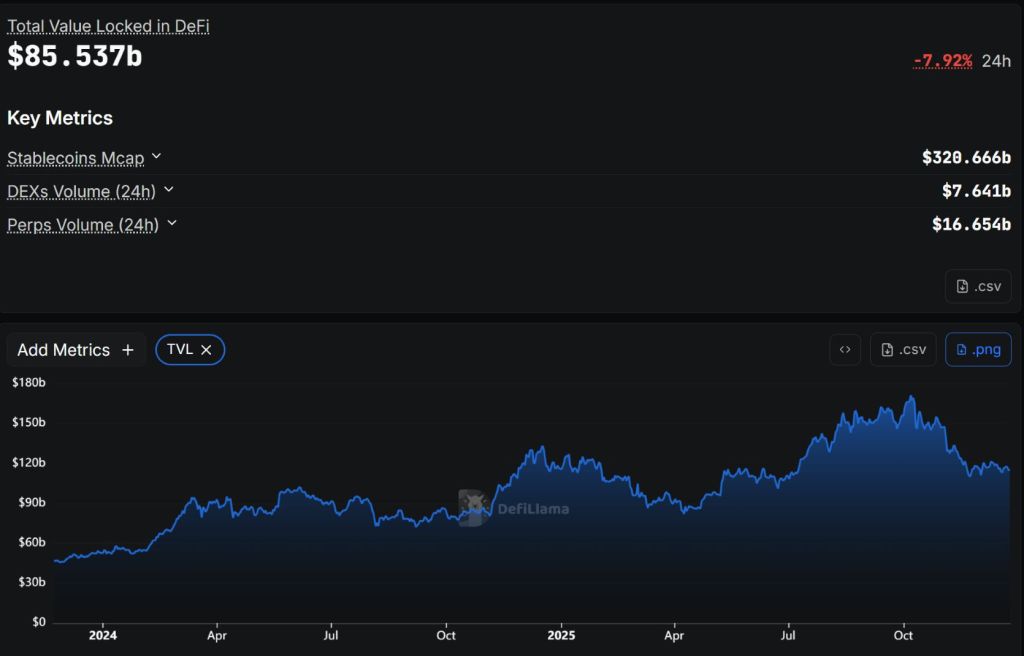
The DeFi market has taken a heavy hit, with nearly $13 billion in TVL (Total Value Locked) erased in just 48 hours.
What initially looked like another isolated exploit has quickly evolved into something much more serious: a full-blown test of the system’s resilience.
The trigger was the KelpDAO exploit, but the damage didn’t stop there. What followed was a rapid unwind driven by panic selling, liquidity outflows, and a growing realisation that the risks in DeFi may be deeper than many assumed.
At the centre of this event is an uncomfortable truth: the exploit didn’t break DeFi, it exposed how it already works.
The attacker leveraged a compromised bridge to introduce unbacked assets into the system, using them as collateral across lending protocols. Platforms like Aave accepted these assets as valid, not because of a flaw, but because they were designed to trust the inputs they receive.
From there, the attacker borrowed real liquidity and exited, leaving behind a hole that the system now has to absorb.
This is where the narrative shifts. For years, DeFi has positioned itself as trustless. In reality, it operates on layers of assumed trust, particularly when it comes to bridged assets. Once that assumption breaks, the consequences spread quickly.
And spread they did.
The $13 billion wipeout wasn’t caused by the exploit alone but by the chain reaction that followed. Liquidations cascaded across multiple protocols, collateral values dropped, and liquidity providers rushed to exit. Within hours, utilisation rates spiked, reserves tightened, and stress began leaking across the ecosystem.
Aave, often seen as the backbone of DeFi lending, has so far remained technically intact. Its fundamentals are still strong, supported by consistent revenue and ongoing development. But even Aave isn’t immune to shifts in sentiment. Total Value Locked has declined sharply, borrowing activity is slowing, and users are becoming increasingly cautious.
That distinction matters. This isn’t about whether Aave is broken – it’s about whether users still trust the environment it operates in.
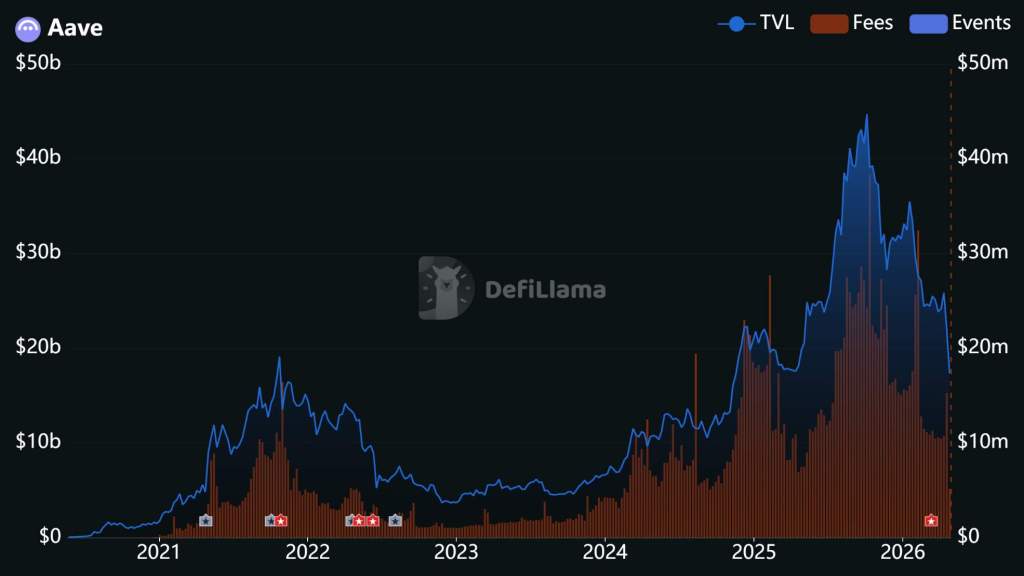
Zooming out, the situation looks even more concerning. The KelpDAO exploit is just one in a series of increasingly sophisticated attacks. 2026 is already shaping up to be the worst year in DeFi security, with hundreds of millions lost in just a few months. What’s changing isn’t just the frequency of exploits, but their complexity.
Attackers are no longer relying on simple vulnerabilities. They’re targeting the edges of the system – bridges, oracles, interfaces, where assumptions are weakest and oversight is harder. The result is a new kind of risk, one that doesn’t always come from within a protocol but from its dependencies.
There’s also a growing technological imbalance. Tools powered by AI are accelerating the discovery of vulnerabilities, and in many cases, attackers are moving faster than teams can respond. That gap is becoming harder to ignore.
Meanwhile, another issue is quietly emerging beneath the surface: bad debt. The exploit has left behind hundreds of millions in liabilities, and only a fraction is covered by insurance mechanisms. The rest will have to be absorbed somehow, raising difficult questions about how decentralised systems handle losses at scale.
All of this is happening in a market where yields are already compressed. For many participants, the equation is starting to look less attractive. Lower returns combined with rising systemic risk make capital flight a rational response, not an overreaction.
So the question isn’t just whether DeFi will recover. It’s how much damage needs to be absorbed before confidence returns.
If history is any guide, DeFi is resilient. It has gone through shocks before, and each time it has adapted. But this moment feels different: not because of the size of the losses, but because of what they reveal.
This isn’t just a hack. It’s a structural wake-up call.
DeFi is moving out of its experimental phase and into something more demanding, where assumptions are tested under pressure and only the most robust designs survive. Protocols like Aave may continue to hold strong fundamentally, but their trajectory will depend less on their own code and more on the stability of the ecosystem around them.
For now, the market is in a defensive posture. Liquidity is cautious, users are more selective, and trust – arguably the most important layer in DeFi – has taken a hit.
Whether this is a temporary shakeout or the beginning of a deeper reset remains to be seen. But one thing is clear: DeFi is no longer being judged on potential.
It’s being tested on survival.
☝Disclaimer: This article is for informational purposes only and does not constitute financial advice. The content of this post reflects solely my own opinions. Purchasing cryptocurrencies poses considerable risk of losses.
Stay informed and level up your crypto strategy
 Sign Up for the Crypto Corner Newsletter and join 10,000+ users to receive my monthly updates and market analysis and keep up to date with the latest releases and developments in the crypto arena.
👉Go to LearnCryptoNow.com for free guides, tutorials and all things crypto

Daily Wisdom
“The only person you are destined to become is the person you decide to be.” – Ralph Waldo Emerson Your destiny is in your…

Onekey Pro 2 Review: All-in-One Hardware Wallet
Looking for a new hardware wallet? Look no further. The OneKey Pro 2 has everything you need, and then some. I just reviewed this…
Quote Of The Day
“Don’t watch the clock; do what it does. Keep going.” – Sam Levenson Resilience and an unwavering spirit are the companions on the journey…


